Mastering Extreme Sudoku: Logic Patterns, Candidate Control, and Precision Solving
When a nine-by-nine grid refuses to yield to simple row and box scans, solving shifts from quick visual spotting to structured deductive geometry. Understanding how candidate constraints ripple across rows, columns, and regions separates hesitant guessing from effortless logical mastery.
Every experienced puzzle solver eventually encounters the wall. For weeks or months, casual grids collapse smoothly under cross-hatching, simple box exclusions, and an occasional obvious pair. You scan for a missing digit across parallel bands, drop a confident number into its sole remaining home, and watch the surrounding cells cascade into place like falling dominoes. Then comes a grid where the opening cascade stalls after three or four placements, leaving dozens of empty squares staring back in stubborn silence.
That quiet impasse is precisely where high-level Sudoku begins. Rather than testing memory or speed of arithmetic, demanding grids examine how cleanly a solver organizes uncertainty. The digits from one through nine hold no numerical weight here; they are nine distinct symbols governed by a rigid network of mutual exclusions. Every empty cell carries a shrinking set of legal possibilities, and every elimination alters the tension across three overlapping houses simultaneously: a row, a column, and a three-by-three block.
Modern digital puzzle environments such as sudokuonline-it.com have made exploring these high-tier challenges far more accessible than paper booklets ever could. With crisp candidate toggles, automatic conflict checks, and structured difficulty tiers, players can devote their cognitive energy to recognizing structural patterns rather than constantly erasing smudged graphite. Yet software assistance cannot replace genuine analytical vision. Even with clean pencil marks on a bright screen, unlocking a stalled extreme grid requires a disciplined playbook of subset logic, fish geometry, wing structures, and alternating inference chains.
Why Traditional Scanning Fails on Ultra-Hard Grids
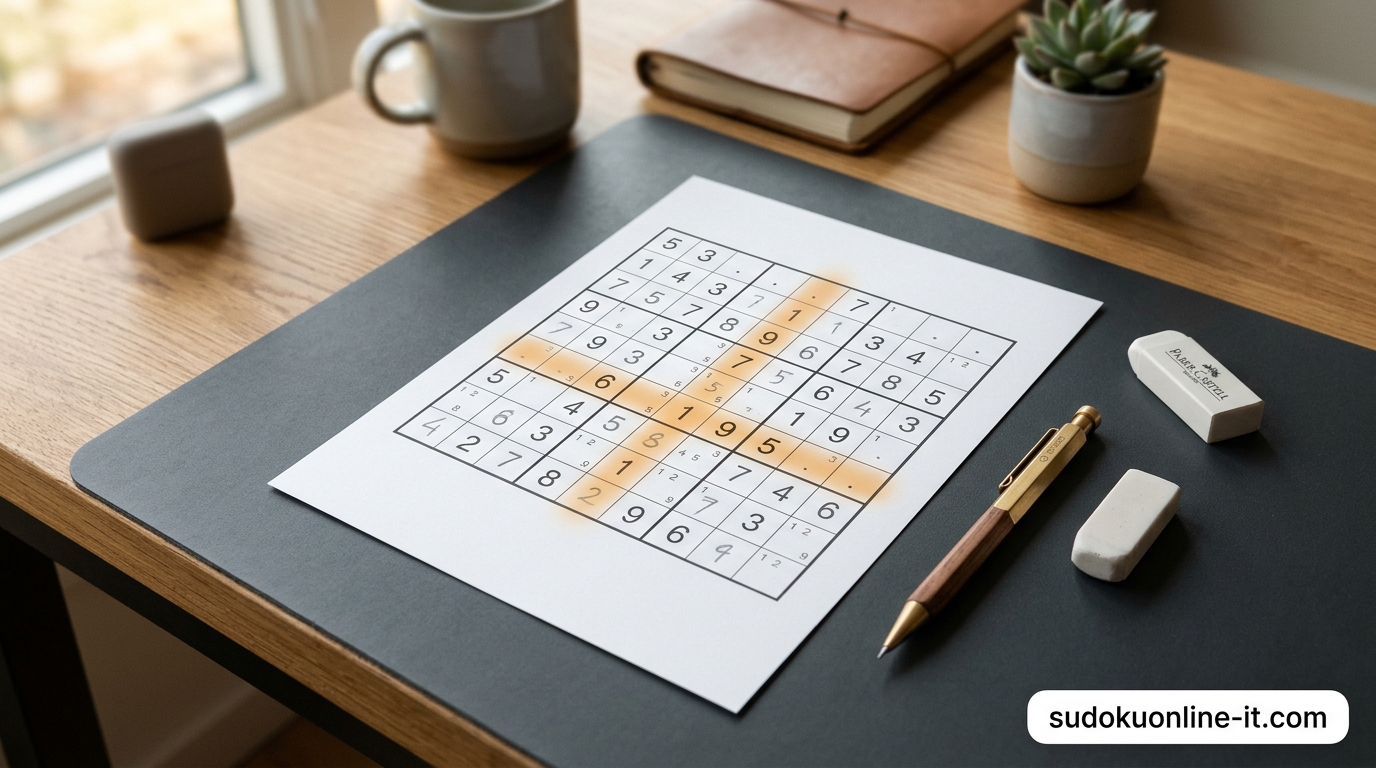
Cross-hatching is the workhorse of introductory solving. By projecting the presence of a digit along two horizontal rows and checking the intersecting vertical columns within a single band, a solver frequently isolates a hidden single without writing a single candidate mark. This technique excels when the grid begins with twenty-eight or thirty well-distributed givens because overlapping restrictions leave minimal breathing room for stray possibilities.
Extreme puzzles are engineered specifically to resist cross-hatching beyond the initial opening moves. Puzzle constructors carefully place clues so that nearly every digit retains multiple viable cells inside each block and line. When a digit still fits into three or four squares per box, projecting lines across a band produces no direct placements. Continuing to scan blindly in circles wastes attention, introduces fatigue, and invites subtle reading errors that derail the entire board minutes later.
The real bottleneck in these puzzles is not a shortage of clues alone, but the distribution of constraint density. A grid can offer twenty-five starting digits and still stall completely if those clues cluster redundantly or preserve symmetrical ambiguity until an advanced pattern breaks the deadlock. Conversely, some sparse puzzles unravel rapidly if their few clues create immediate pointing pairs that cascade across multiple chutes. Learning to diagnose why a grid has stalled tells you which analytical lens to pick up next.
Clue Count Versus Structural Complexity
Beginners often assume that fewer starting numbers automatically produce a harder puzzle, yet combinatorial testing shows a far more nuanced relationship. While mathematically proven minimum grids require at least seventeen clues to guarantee a single unique solution, many twenty-two-clue puzzles feel straightforward compared to carefully tuned twenty-four-clue layouts. What governs true difficulty is the minimum logical depth required to force the next elimination.
When a grid requires only singles and basic locked candidates, its logical tree remains shallow because each step considers at most one house or one band at a time. Extreme puzzles demand non-local reasoning: you must connect possibilities across distant corners of the board, noticing how an assumption in the upper-left corner forces a contradiction in the lower-right box. Until a solver learns to track relationships between candidates rather than waiting for finished digits, those non-local locks remain invisible.
Moving From Placement Mentality to Elimination Mentality
Perhaps the biggest psychological shift in advanced solving is celebrating an elimination just as much as placing a big digit. On intermediate boards, players feel progress only when a square fills in. On extreme grids, placing a digit is often just the delayed reward for ten quiet candidate deletions executed earlier. Every time you prove that a candidate cannot occupy a particular cell, you sharpen the geometry of the remaining possibilities and bring hidden structures closer to the surface.
Adopting an elimination mindset also protects accuracy. Instead of asking where a digit goes, start asking which digits are genuinely chained together and which cells carry false options. When two digits are restricted to the exact same pair of squares, eliminating every other candidate from those two squares unlocks information even though neither square is solved yet. That shift in perspective turns stalled boards from frustrating dead ends into fascinating logical puzzles.
Disciplined Pencil Marking and Candidate Hygiene
Nothing undermines an advanced solve faster than sloppy notation. Writing every candidate into every empty cell from move zero floods the board with visual noise, burying subtle patterns under dozens of tiny digits. On the other hand, refusing to write pencil marks at all forces working memory to juggle too many conditional links simultaneously, leading to missed pairs and phantom deductions. Effective solvers treat notation as a dynamic microscope that zooms in gradually as the puzzle tightens.
Restricted notation, commonly called Snyder notation, limits candidate marks inside each three-by-three block to digits that can occupy only two cells within that block. Because every mark carries strong relational meaning—if one cell is false, the partner cell must be true—Snyder notation keeps the grid remarkably clean. Whenever a solved digit lands on one of those two cells, the partner resolves automatically without re-scanning the entire block.
However, Snyder notation has a natural ceiling. Once a grid enters advanced territory where X-Wings, XY-Wings, or multi-digit chains govern progress, restricting marks to two-per-box hides crucial bivalue cells and three-candidate alignments across rows and columns. Recognizing the exact moment to transition from sparse box marks to full candidate grids is an essential habit. Once cross-hatching and two-per-box intersections run dry, systematically populating remaining candidates turns hidden alignments into visible targets.
Pointing Pairs and Box-Line Reduction
Before invoking complex multi-step chains, disciplined solvers exhaust every box-line interaction. A pointing pair or triple occurs when all remaining candidates for a digit inside a three-by-three block happen to lie along a single row or column. Since that block must contain the digit somewhere, and every available spot lies inside that shared line, the digit is locked into that intersection and can be safely removed from all other cells along the same row or column outside the block.
Box-line reduction works in the mirror direction. Suppose you examine an entire row and discover that all remaining candidates for a specific digit sit inside a single three-by-three block. Regardless of which exact square in that row eventually claims the digit, the block itself has its requirement fulfilled along that row. Consequently, every other cell inside that block outside the row must surrender that candidate. Alternating between pointing checks and box-line reductions cleans up surprising amounts of candidate clutter before harder patterns even need to be hunted.
Spotting Naked and Hidden Subsets Under Pressure
Subset logic builds directly on the pigeonhole principle: when a fixed number of cells within a house collectively hold the exact same fixed number of candidates, those candidates are locked to those cells, and those cells cannot harbor anything else. A naked pair appears when two cells in the same row, column, or box contain identical pairs of remaining digits and nothing more. Even though you do not yet know which cell takes which digit, no other square in that house can legally use either value.
Naked triples and naked quads extend this logic smoothly, though many solvers misapply them because they look for three cells all showing three identical digits. In reality, a naked triple only requires that three cells collectively draw from a shared pool of three digits. A set of cells containing pairs like AB, BC, and AC forms a perfectly valid naked triple because those three squares cannot possibly accommodate all three values unless every single instance of A, B, and C in that house belongs exclusively to them.
Hidden subsets mirror naked subsets from the opposite angle. Instead of looking for cells with very few candidates, you look for digits that appear in very few cells within a house. If two digits appear together in the same two cells of a column and nowhere else in that column, they form a hidden pair. Even if those two cells look cluttered with four or five extra candidates, every extra option inside them must be erased immediately. Often, clearing away those extraneous candidates exposes an underlying naked pair or reduces a square down to a single decisive digit.
Fish Patterns: From X-Wing to Swordfish and Jellyfish
Once box-line interactions and subsets have stripped away obvious redundancy, single-digit fish patterns often provide the cleanest breakthrough. Unlike wing structures that compare different numbers inside shared cells, fish patterns track a single digit across parallel lines. The logic relies on symmetry between base sets and cover sets: if a digit appears only within a select group of rows, and all of those appearances align inside an equal number of columns, then each of those columns is spoken for by those rows.
Think of fish patterns as generalized locked lines expanded into two dimensions. Rather than looking at one row intersecting one box, you compare two, three, or four rows intersecting two, three, or four columns. Because the symmetry works identically in both orientations, every column-based fish has a row-based twin. Training your eyes to highlight one digit at a time across the entire board makes fish geometry stand out dramatically against the background grid.
Executing the X-Wing Elimination
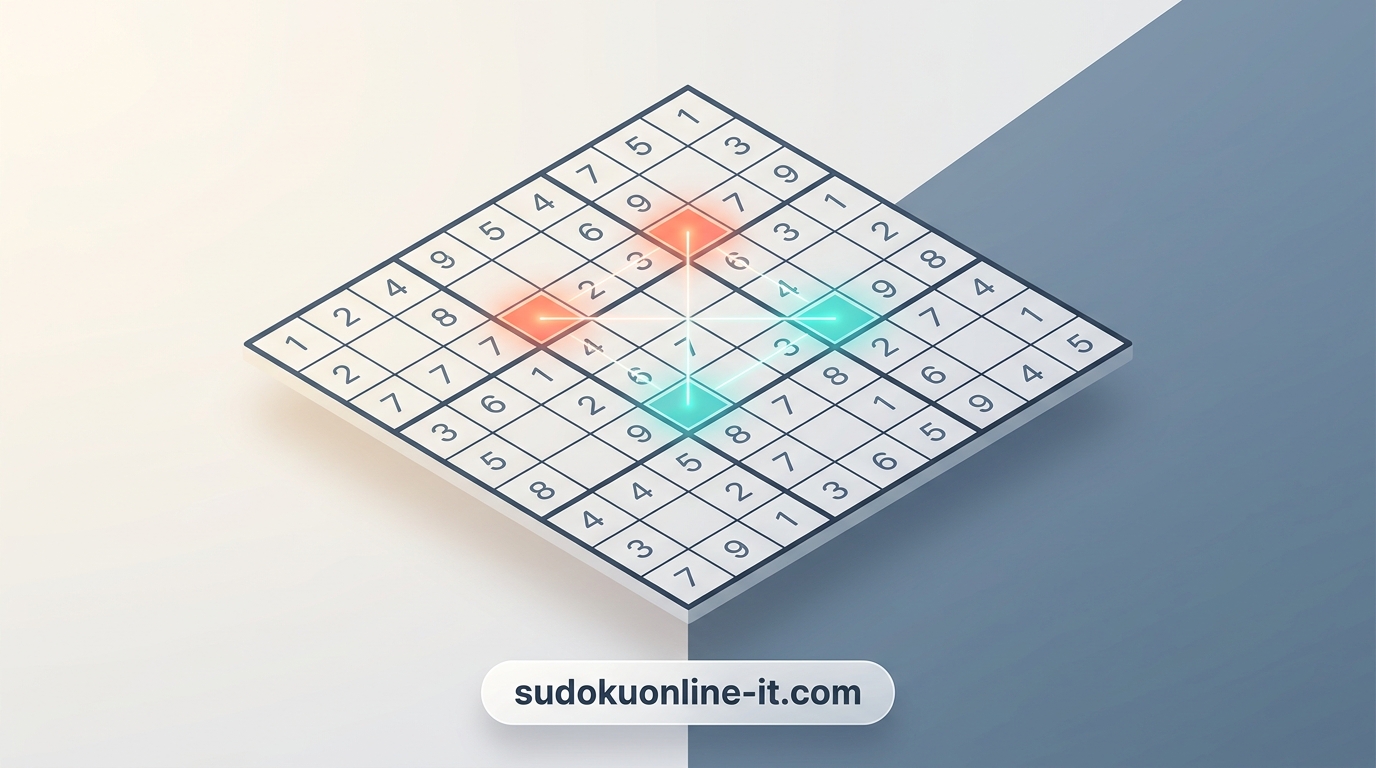
The X-Wing is the smallest and most frequent fish formation, spanning two base lines and two cover lines. Suppose you highlight the digit seven across the grid and examine two separate rows. In both rows, seven appears as a candidate in only two columns, and remarkably, those two columns match identically between both rows. Visually, the four candidate cells trace the four corners of a crisp rectangle.
Trace the two valid ways those rows can place seven: either the upper-left corner and lower-right corner hold seven, or the upper-right corner and lower-left corner do. Notice that in both valid arrangements, both vertical columns receive their required seven from one of those two rows. Because neither column can host a second seven anywhere else, every other candidate seven sitting inside those two columns outside the rectangle must be eliminated immediately. That single rectangular observation frequently unblocks columns that appeared completely frozen.
Scaling Up to Swordfish Formations
A Swordfish extends the X-Wing from two lines to three. You locate three parallel rows—or three parallel columns—in which a target digit appears at most three times per line, and all candidate positions across those three lines fall collectively inside just three intersecting perpendicular lines. A common misconception holds that every row in a Swordfish must contain all three columns. That is unnecessary; each row only needs two or three candidates, provided the combined footprint across all three rows stays confined within the same three columns.
For instance, row A might have candidates in columns two and five, row B in columns five and eight, and row C in columns two, five, and eight. Together, those three rows use only columns two, five, and eight. Since three rows require three placements of the digit and only three columns are available to receive them, those three columns are completely saturated by those three rows. Any stray candidate for that digit lurking in columns two, five, or eight on any other row can be safely deleted.
Finned and Sashimi Variations
Real-world extreme puzzles rarely hand you textbook symmetrical Swordfish without resistance. Often, an X-Wing or Swordfish looks almost pristine except for one or two annoying extra candidates sitting inside one of the base rows inside the same three-by-three box as a corner cell. Rather than discarding the pattern, advanced solvers evaluate it as a finned fish. The extra candidate—or cluster of candidates confined to a single box—acts as a fin.
The logic splits neatly into two mutually exclusive cases. Case one assumes the fin is false, which restores the pure un-finned fish and validates all standard cover-line eliminations. Case two assumes the fin is true, which immediately eliminates the target digit from every cell sharing a three-by-three box with the fin itself. Therefore, any cell that belongs simultaneously to a standard fish cover line and shares the same box as the fin loses that candidate regardless of which case holds. Finned X-Wings appear regularly in hard puzzles and bridge the gap between basic patterns and true chain logic.
Wing Structures and Alternating Inference Chains
When single-digit symmetries run their course, attention shifts toward bivalue cells—squares narrowed down to exactly two candidate digits. A bivalue cell acts like a logical toggle switch: if one candidate proves false, the other must instantly become true. Linking these switches across overlapping houses unlocks wing patterns and alternating inference chains, allowing solvers to crack puzzles that completely resist single-digit techniques.
The elegance of wing logic lies in its compactness. Instead of simulating an entire branch of moves down the board, you inspect three or four tightly coupled cells and establish a guaranteed forced outcome for any shared neighbor. Because wing structures rely entirely on direct cell visibility rather than speculative trial and error, they remain fast to verify and rock-solid under pressure.
Unlocking Stalemates with XY-Wing and XYZ-Wing
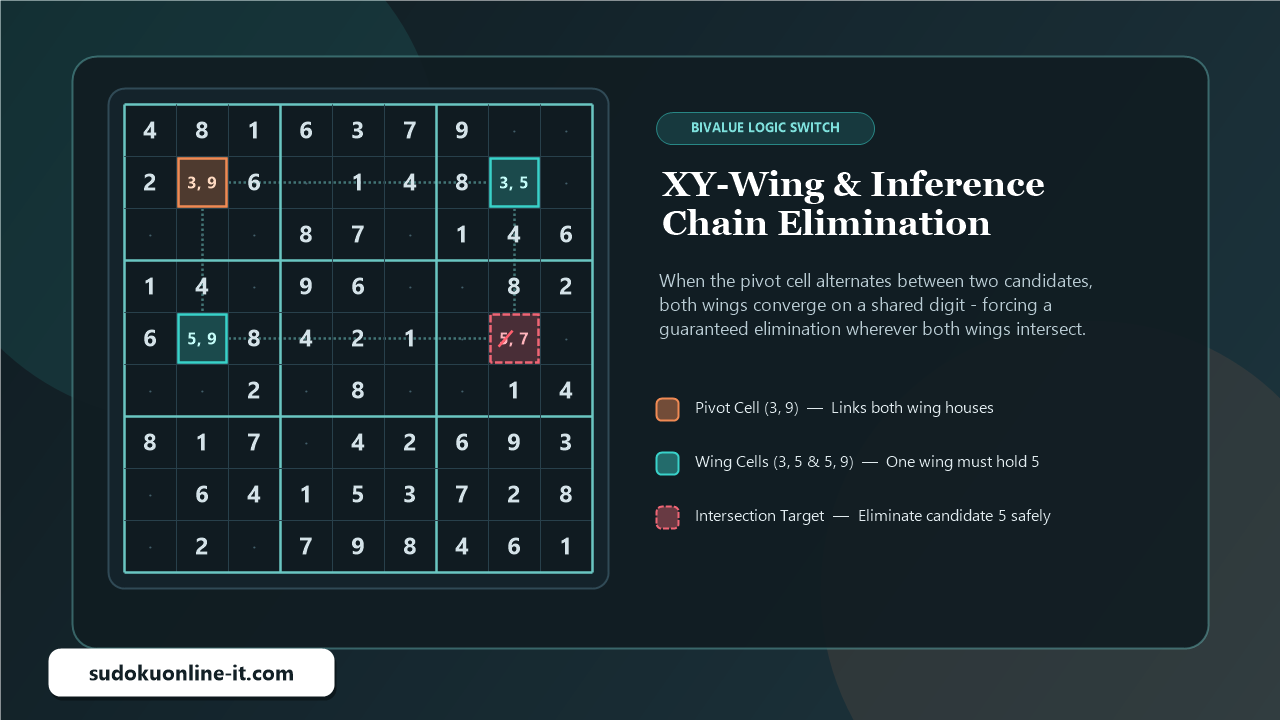
An XY-Wing forms around three bivalue cells: one pivot cell and two wing cells that each share a house with the pivot, though the wings do not need to see each other directly. The pivot holds candidates X and Y. One wing holds X and Z, while the second wing holds Y and Z. Notice how the pivot controls both wings simultaneously. If the pivot resolves to X, the first wing is forced to become Z. Conversely, if the pivot resolves to Y, the second wing is forced to become Z.
In every legal scenario, at least one of the two wings ends up holding Z. Consequently, any external cell located where it can see both wing cells simultaneously—meaning it shares a row, column, or box with wing one and a row, column, or box with wing two—can never contain Z. Removing Z from those common intersections frequently collapses a neighboring bivalue square into an immediate placement.
An XYZ-Wing tightens the hinge slightly by letting the pivot hold all three digits: X, Y, and Z. The wings still hold XZ and YZ respectively. Now, whichever value lands in the pivot—whether X, Y, or Z—either the pivot itself becomes Z or one of the two wings is forced to become Z. The trade-off is a smaller elimination zone: instead of eliminating Z from cells seeing just the two wings, an eligible target must see all three cells (the pivot and both wings), which usually means sitting inside the same box as the pivot while aligning along the line of the opposing wing.
Simple Coloring and Medusa Logic
When wing patterns are absent, chains of strong links offer a structured way to map long-distance dependencies. A strong link exists whenever two instances of a digit are the sole remaining options inside a house—if one is false, the other must be true. By starting at one strong link and alternating colors (say, teal and amber) along connected conjugate pairs for a single digit, you divide a chain of candidates into two opposing parity teams: either every teal cell holds that digit, or every amber cell does.
Once a simple color chain is built, two clean elimination triggers emerge automatically. First, if two cells carrying the same color ever land inside the same row, column, or box, that entire color represents an impossibility, allowing you to confirm every cell of the opposite color in a single sweep. Second, if any uncolored cell outside the chain sees at least one teal cell and one amber cell simultaneously, that uncolored cell can never contain the digit because one of those two colored teams is guaranteed to claim it.
Multicolor chains, often grouped under three-dimensional Medusa logic, expand this coloring concept from one digit to multiple digits by hopping across bivalue cells as well as conjugate pairs inside houses. Within a bivalue square holding A and B, A receives one color and B receives the opposite color, creating a seamless bridge from single-digit chains to multi-digit networks. Even short five-node alternating inference chains routinely slice through puzzles rated near the very top of published difficulty scales.
Building Speed, Focus, and Error-Free Verification
Knowing the definitions of advanced patterns is only half of solving skill; spotting them reliably without mental fatigue is the other half. The human eye struggles when scanning a cluttered grid aimlessly because there is no consistent anchor for attention. Top competitive and recreational solvers counteract this by running a fixed inspection loop whenever a grid stalls, checking patterns in strict order from cheapest cognitive cost to highest.
A smooth inspection rhythm begins with newly altered houses: every time you place a digit or clear a candidate, immediately re-examine that row, column, and box for fresh singles or pointing lines before drifting elsewhere. When local waves settle down, sweep digits one through nine sequentially for box-line reductions and two-line X-Wing rectangles. Only after single-digit scans turn up empty should you pivot toward scanning bivalue clusters for XY-Wings, W-Wings, and coloring chains.
Players who consistently master these chained eliminations often seek out a true fiendish sudoku challenge where basic scanning yields almost nothing after the opening moves. Facing that kind of dense logical resistance tests whether your habits hold together under prolonged uncertainty. Rather than rushing toward speculative guesses—which destroy the satisfaction of pure deduction and frequently force messy rollbacks—staying patient with systematic candidate pruning turns intimidating grids into steady, rewarding climbs.
Managing Working Memory During Multi-Step Chains
Long inference chains tax working memory because keeping track of alternating true-and-false hypotheses across six or seven cells invites slips. To keep cognitive load low, practice identifying anchor nodes—high-degree bivalue cells that connect cleanly to multiple houses. Start every chain from a cell that already participates in at least two strong links so your reasoning branches productively rather than fizzling out after two steps.
Verbalizing link types silently also prevents logical inversion errors, which are the single most common mistake in advanced solving. Remind yourself of the exact rule as you step forward: a strong link lets you jump from false to true, whereas a weak link (sharing a house with other candidates) only lets you jump from true to false. Alternating strictly between strong and weak steps guarantees mathematical soundness at every link of the chain without needing to hold hypothetical sub-boards in your head.
Common Pitfalls That Corrupt Advanced Grids
Even seasoned solvers occasionally watch an entire thirty-minute solve collapse because of a tiny mechanical error twenty moves earlier. Understanding the recurring failure modes helps build defensive habits that keep long solves spotless:
- Incomplete candidate updates after placements: Placing a solved digit inside a box automatically invalidates that digit in the intersecting row and column too; forgetting to wipe the perpendicular lines leaves phantom candidates that fabricate fake X-Wings later.
- Confusing weak links with strong links: Assuming that because two cells share a row they form a conjugate pair when a third candidate sits unnoticed elsewhere in the same row corrupts coloring parity instantly.
- Over-pruning finned patterns: Eliminating cells outside the fin's local box during a finned X-Wing or Swordfish assumes the fin cannot be true, invalidating logic whenever the fin turns out to hold the solution.
- Neglecting re-scans after subtle deletions: Dropping a single candidate via an XY-Wing often converts a three-option line into a pointing pair; jumping straight into another complex chain wastes effort when an easy box-line reduction just opened right beside it.
Frequently Asked Questions About Extreme Sudoku Strategy
Should you guess when a grid appears completely stuck?
True well-formed Sudoku puzzles never require blind guessing; every valid puzzle generated for human solving admits a deterministic path using logical patterns. Guessing—sometimes disguised as unguided bifurcation—breaks the chain of deductive proof and leaves you uncertain whether a later contradiction came from an earlier typo or the branch choice itself. Whenever a board looks impossible, check first for an overlooked hidden pair, a missing candidate update, or a simple finned X-Wing before assuming higher-order chains are required.
When should a solver switch from Snyder notation to full candidates?
Snyder notation shines during the first half of most tough puzzles because it isolates box-level pairs without cluttering every square. The ideal switching moment arrives when scanning all nine digits produces zero new singles, zero pointing pairs, and zero obvious naked pairs among your sparse marks. At that point, filling in full candidates across the remaining open cells brings bivalue clusters, hidden triples, and multi-line fish patterns directly into view.
Are high-clue puzzles always easier than low-clue puzzles?
Not necessarily. Although minimal clue counts often correlate with sparse early constraints, puzzle designers can arrange twenty-six or twenty-eight givens so that every intuitive placement stops dead until an obscure wing or chain breaks symmetry. Difficulty depends on the sophistication of the logical deductions required to progress, not merely how many empty squares wait at the start.
How long does it typically take to learn advanced chaining techniques?
Most solvers comfortable with naked subsets can absorb X-Wings, pointing interactions, and basic XY-Wings within a couple of focused weeks of practice. Alternating inference chains and Medusa coloring take a bit longer—often several weeks of deliberate pattern drilling—because reading strong versus weak links quickly requires visual familiarity. Practicing one technique deliberately across several puzzles in a row builds pattern recognition far faster than solving random boards passively.
Developing Long-Term Deductive Fluency
Mastering extreme Sudoku is rarely about memorizing exotic jargon; it is about learning to read constraint pressure cleanly across an entire board. When you stop viewing a nine-by-nine grid as eighty-one disconnected boxes and begin seeing overlapping lines of mutual exclusion, the hardest puzzles lose their intimidation. Each pointing pair trims the noise, each fish pattern compresses sprawling possibilities, and each wing structure turns stubborn bivalue switches into decisive breakthroughs.
By keeping candidate notation disciplined, verifying strong links patiently, and treating every clean elimination as genuine progress, solvers build an intuition that feels remarkably calm even on unforgiving layouts. Whether you unwind with a single thoughtful challenge alongside morning coffee or train systematically for timed logic competitions, consistent adherence to clean deduction turns every blank square into a rewarding test of clarity and patience.